
Black and White Wedding Photography: 5 Best Moments
By Thalia Reisi, Communications Manager at Libre Comme l'Art, founded by Michaël Guez.
Ask a couple about their wedding the next morning and they will mention the ceremony, the dress, the first dance. Ask their guests a month later and you will hear something else: a hat, a curtain, a picture that made a whole table laugh.
That is the hour we plan around when a couple asks for a wedding photo booth Paris guests will actually use. Libre Comme l’Art photographs weddings and portraits in Paris, and we have watched enough evenings to know how a night with a booth tends to go.
1. Getting ready: the hands and the fabric
Lace, ribbon, a mirror, a hand tying a knot. Getting-ready scenes are full of texture and pale fabrics, and in color they're often dominated by the room itself: beige walls, mismatched lamps, a hotel carpet. In black and white, the room steps back and the details stay: the weave of the lace, a curl of hair, a lipstick raised toward a window.

2. Silhouettes at the window
A row of people against a bright window is a problem in color: dark faces, a blown-out sky, a muddy middle. In black and white,
it becomes a graphic image: profiles, shapes, a hand adjusting a bow tie. Backlight, the thing most photographers avoid indoors, is exactly what black and white handles best.
3. The kiss and the walk out
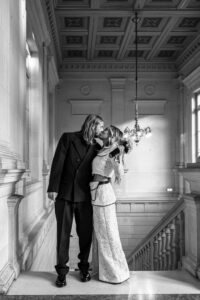
Ceremonies are crowded: guests in every color, phones in the air, flower arrangements competing with the couple. Black and white calms the frame. Faces carry it: the couple, the front row, a grandmother watching. The kiss at the end of a civil ceremony, the walk back down the aisle with arms raised. Emotion reads the same in any room, and black and white lets it read first.
4. Portraits in hard light
Winter sun at noon, a stone street, a fur stole. Hard light is a challenge in color: sharp shadows, squinting, uneven skin tones. In black and white, it gives the image its structure. Contrast, texture, and depth do the work, and faces are sculpted instead of washed out.
5. The reception, under mixed light
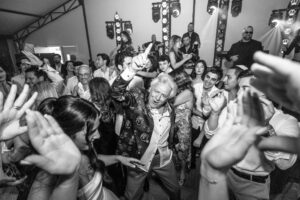
Colored uplighting, candles, LED effects, warm lamps: a reception room often mixes five light sources, and skin tones suffer. Black and white removes the problem. The speeches, the first dance, the cake cutting: everything reads as one gallery, whatever the venue's bulbs were doing.
When to keep the color
Black and white works best as a choice, not a default. A bouquet, a bold dress, a decorated table, a sunset sky: some images lose half their point without color. Most galleries need both.
If you're still comparing photographers, start with how to choose the right one. And if you'd like to see how your day could look in black and white, get in touch or follow us on Instagram.
FAQ: Black and White Wedding Photography
Does black and white suit every wedding? Not every moment, but almost every wedding has moments where it works. Mixed lighting, strong backlight, and busy backgrounds are where it helps most.
Will black and white photos look dated? They tend to age slowly. Without color, there are fewer cues tied to a particular year: a fabric shade, a decor trend, a filter.
Do we have to choose before the wedding day? With digital photography, the black and white version is a choice made at editing, so the day itself is shot the same way. If you have a strong preference, tell your photographer in advance so the gallery can be planned around it.
Which moments should stay in color?Anything where color is the subject: the bouquet, the table setting, a dress with a bold color, the sky at sunset.


